


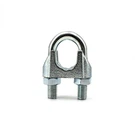


As a shackle supplier, ensuring the quality of our products is of utmost importance. Shackles are critical components used in various industries, including marine, construction, and transportation. They are designed to connect different parts of a system, and any failure can lead to serious consequences. In this blog, I will share some of the key methods we use to verify the quality of shackles.


Material Inspection
The first step in verifying the quality of a shackle is to inspect the material. The material used in shackles should have high strength, good toughness, and corrosion resistance. We typically use high - grade steel, such as alloy steel, for our shackles.
We check the material certificates provided by the steel suppliers. These certificates contain detailed information about the chemical composition and mechanical properties of the steel. For example, the carbon content, which affects the strength and hardness of the steel, should be within a specific range. We also look at the presence of other alloying elements like manganese, chromium, and nickel, which can enhance the steel's performance.
In addition to the certificates, we conduct our own material tests. One common test is the hardness test. We use a hardness tester to measure the hardness of the shackle at different points. A consistent hardness across the shackle indicates proper heat treatment and a uniform material structure. If the hardness is too high, the shackle may be brittle and prone to cracking. On the other hand, if it is too low, the shackle may not have sufficient strength to withstand the intended loads.
Dimensional Accuracy
Accurate dimensions are crucial for the proper functioning of a shackle. We use precision measuring tools, such as calipers and micrometers, to measure the key dimensions of the shackle. This includes the diameter of the pin, the width and height of the bow, and the overall length of the shackle.
The dimensions must comply with the relevant industry standards. For example, the Galvanized US Type Bolt Type Chain D Shackle G2150 follows specific dimensional requirements set by the US standards. Any deviation from these standards can affect the fit and performance of the shackle. If the pin diameter is too large, it may not fit properly into the holes of the connected components. If it is too small, it may not provide enough strength to hold the load.
We also check the surface finish of the shackle. A smooth surface finish not only improves the appearance but also reduces the risk of stress concentration. Rough surfaces can act as stress raisers, which can lead to premature failure of the shackle under load.
Non - Destructive Testing
Non - destructive testing (NDT) methods are used to detect internal and surface defects in the shackle without damaging it. One of the most commonly used NDT methods is magnetic particle testing (MPT). This method is suitable for ferromagnetic materials, such as the steel used in our shackles.
In MPT, a magnetic field is applied to the shackle, and magnetic particles are sprayed on the surface. If there are any surface or near - surface defects, such as cracks, the magnetic field will be disrupted, and the magnetic particles will accumulate at the defect location, making it visible.
Another important NDT method is ultrasonic testing (UT). UT uses high - frequency sound waves to detect internal defects in the shackle. A transducer sends ultrasonic waves into the shackle, and any defects in the material will cause the waves to reflect back. By analyzing the reflected waves, we can determine the size, location, and type of the defect.
Load Testing
Load testing is the most direct way to verify the strength and performance of a shackle. We conduct both static and dynamic load tests on our shackles.
In static load testing, a gradually increasing load is applied to the shackle until it reaches its rated capacity. The shackle is then held under this load for a certain period of time to check for any signs of deformation or failure. For example, if a shackle is rated for a 5 - ton load, we will apply a 5 - ton load and monitor it for 5 minutes. If there is no visible deformation or failure during this time, the shackle passes the static load test.
Dynamic load testing is used to simulate the real - world operating conditions of the shackle. In this test, the shackle is subjected to repeated loading and unloading cycles. This helps us to determine the fatigue life of the shackle. A high - quality shackle should be able to withstand a large number of cycles without failure.
Corrosion Resistance Testing
Since shackles are often used in harsh environments, corrosion resistance is an important quality factor. We perform corrosion resistance tests on our shackles to ensure they can withstand the effects of corrosion over time.
One common test is the salt spray test. In this test, the shackle is placed in a salt spray chamber, where a fine mist of saltwater is sprayed onto the surface of the shackle for a specified period of time. After the test, we examine the shackle for signs of corrosion, such as rust spots or pitting. The US Standard Bolt Type Anchor Bow Shackle G2130 is designed to have good corrosion resistance, and the salt spray test helps us to verify this.
We also use protective coatings, such as galvanizing, to enhance the corrosion resistance of our shackles. Galvanizing creates a zinc coating on the surface of the shackle, which acts as a sacrificial anode, protecting the steel from corrosion.
Visual Inspection
Visual inspection is a simple but important part of the quality verification process. We carefully examine the shackle for any visible defects, such as cracks, scratches, or misaligned parts. A visual inspection can often detect surface defects that may not be detected by other methods.
We also check the markings on the shackle. The markings should clearly indicate the rated load, the material, and the manufacturing standards. This information is essential for the proper use and safety of the shackle.
As a shackle supplier, we are committed to providing high - quality products to our customers. By using a combination of these quality verification methods, we can ensure that our shackles meet the highest standards of quality and safety. If you are in the market for shackles, such as the Jis Type Screw Pin Chain Dee Shackle with Counter Sunk Head, and want to discuss your specific requirements, please feel free to contact us for procurement and further technical discussions.
References
- ASME B30.26 - Safety Standard for Slings
- ASTM A952 - Standard Specification for Alloy Steel Chain Shackles
- ISO 2415 - Rigging Shackles - Safety