


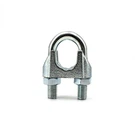


Hey there! I'm a shackle supplier, and I often get asked about how to calculate the working load limit (WLL) of a shackle. It's a crucial topic, especially for those in industries like construction, shipping, and rigging. In this blog, I'll break down the process and share some insights to help you understand it better.
First off, let's talk about what the working load limit actually means. The WLL is the maximum amount of weight or force that a shackle can safely handle under normal working conditions. It's not the same as the ultimate breaking strength, which is the force required to actually break the shackle. The WLL is a much lower value, designed to provide a safety margin and ensure that the shackle doesn't fail during regular use.
There are several factors that go into calculating the WLL of a shackle. One of the most important is the material the shackle is made from. Different materials have different strengths, so a shackle made from high - strength alloy steel will have a higher WLL than one made from a lower - grade material. For example, stainless steel shackles are popular because they're corrosion - resistant, but their strength can vary depending on the specific grade of stainless steel used.


The design of the shackle also plays a big role. There are various types of shackles, like the Euro Type Large Bow Shackle, the Trawling Chain Shackle with Square Head Pin, and the Jis Type Screw Pin Chain Dee Shackle. Each type has a different shape and structure, which affects how it distributes the load. A bow shackle, for instance, has a larger, rounded body that can handle loads from multiple directions better than a dee shackle, which is more suitable for loads in a single line.
The size of the shackle is another key factor. Generally, larger shackles can handle more weight. This is because they have a greater cross - sectional area, which means there's more material to resist the force. But it's not just about the overall size; the diameter of the pin and the width of the bow or dee also matter. A thicker pin can withstand more shear force, and a wider bow or dee can distribute the load more evenly.
Now, let's get into the actual calculation. In most cases, the manufacturer will provide the WLL for their shackles. They do this by conducting rigorous testing in a laboratory setting. They'll apply a gradually increasing load to the shackle until it reaches a certain point of deformation or failure. Based on these tests, they'll determine a safe working load limit that takes into account a safety factor.
The safety factor is a multiplier that's used to ensure the shackle can handle unexpected loads or stresses. A common safety factor for shackles is 4:1. This means that the ultimate breaking strength of the shackle is at least four times the working load limit. So, if a shackle has a WLL of 1 ton, its ultimate breaking strength should be at least 4 tons.
But if you want to do a rough estimate on your own, here's a simple way. First, you need to know the yield strength of the material. The yield strength is the point at which the material starts to deform permanently. You can usually find this information in material property tables.
Let's say you have a shackle made of a steel with a yield strength of 40,000 psi (pounds per square inch). You also need to know the cross - sectional area of the part of the shackle that's under the most stress. For a simple dee shackle, this might be the cross - section of the pin.
If the pin has a diameter of 0.5 inches, the cross - sectional area (A) of the pin can be calculated using the formula for the area of a circle: A = π*(d/2)^2, where d is the diameter. So, A = 3.14*(0.5/2)^2 = 0.196 square inches.
To find the maximum load the pin can handle based on the yield strength, you multiply the yield strength by the cross - sectional area. So, the maximum load (P) = 40,000 psi * 0.196 square inches = 7840 pounds.
But remember, this is just the maximum load based on the yield strength. You still need to apply a safety factor. Using a 4:1 safety factor, the working load limit would be 7840 pounds / 4 = 1960 pounds.
It's important to note that this is a very simplified calculation and is only for a rough estimate. There are many other factors that can affect the actual WLL, like the way the shackle is attached, the type of load (static or dynamic), and the environmental conditions.
When you're using shackles in the real world, you should always follow the manufacturer's guidelines and use shackles that are rated for the specific application. If you're unsure about the WLL of a shackle, don't take any chances. It's better to consult with the manufacturer or a professional engineer.
At our company, we're committed to providing high - quality shackles with accurate WLL ratings. We understand that safety is paramount in your operations, and that's why we invest in top - notch testing and quality control. Whether you need a Euro Type Large Bow Shackle for a heavy - duty lifting job or a Jis Type Screw Pin Chain Dee Shackle for a marine application, we've got you covered.
If you're in the market for shackles or have any questions about working load limits, don't hesitate to reach out. We're here to help you make the right choice for your needs. Contact us today to start a conversation about your shackle requirements.
References
- Machinery's Handbook, 31st Edition
- American Society of Mechanical Engineers (ASME) standards for rigging hardware
- International Organization for Standardization (ISO) standards for shackles